
Introduction

Welcome to this module on entrepreneurship in the digital era. In this course, you will explore how everyday problems can become opportunities for action and learning. Entrepreneurship is not only about starting a business or using advanced technology, it’s about creativity, problem-solving and making smart choices with the tools you already have.

You will learn through real examples, short activities, and reflection. Take your time, stay curious and remember – small ideas and small steps can lead to meaningful change.

Let’s begin.

Approximately 90 minutes

Evaluate Your Suitability to Become an Entrepreneur – A Self-Assessment Task

Consider your own abilities and take this 2-part test to assess your suitability for entrepreneurship. To complete this task, copy the summary of the test results and submit where? Or just save to your own documents?

Suitability to become an entrepreneur – Yrittäjyystestit – ELY keskus

The Importance of Business and Entrepreneurship in Society

Business plays a vital role in every community. Understanding the importance of business helps us see how

Companies Create Jobs:

  • Can you name some of the biggest employers in your area?

Companies Boost Growth and Innovation: Companies help the economy grow. Competition between companies promotes innovation, and companies contribute to the overall well-being of society.

  • What innovations come from your country?

Companies Generate Tax Revenue: Businesses and their employees directly and indirectly fund the majority of public expenses by paying taxes on their profits or salaries.

Companies Engage in Foreign Trade:

  • Which products are exported from your country?

Companies provide goods and services: This gives consumers the possibility to choose products and services that best suit their needs. Consumers can influence a company’s development through their purchasing decisions.

For entrepreneurs, running a business provides both employment and income. It also gives them a chance to fully utilize their skills.

Learning outcomes

Module overview

Access all learning resources for this module, including materials, activities, case studies, summaries, and quizzes.

1. Developing a Business Idea and the Possibilities to Implement it

Evaluating a Business Idea and Its Viability

Content and Tasks:

  • Developing a business idea
  • SWOT Analysis: Assessing risks and opportunities (Internal and external factors)
  • Business Model Canvas (BMC)
  • Information sources that support starting a business
  • Assessing the business idea and the possibilities to implement it

The student

  • generates a business idea considering customers’ needs
  • finds key services and information sources that support setting up a business
  • determines the networks required to realize the business idea
  • assesses the financial preconditions for implementing the business idea
  • assesses their capacities for working as an entrepreneur
  • determine the risks and opportunities involved in business

2. Business Idea

A business idea expresses the core purpose of the business. It answers these key questions: what, why, to whom, and how.

What makes a business idea viable? Search for information about business ideas, using several internet sources. Generate a business idea for a business that is under planning, imaginary, or maybe already existing.

Your approach should be customer-centered and cost-efficient, also taking into consideration the current business environment.

To create a business idea, follow these key steps:
  1. Identify a Need or Problem: Look for needs or issues not met in your community or industry that you can address.
  2. Innovate: Develop a unique solution or improve an existing product or service.
  3. Evaluate Feasibility: Is the idea practical and profitable? Do you have the resources, skills, and market demand?
  4. Market Research: Understand your target market, competition, and trends.
  5. Revenue Model: Plan how your business will make money.

These steps provide a foundation for developing a solid business idea.

3. SWOT analysis

To succeed as an entrepreneur, you must be prepared to take calculated risks. Business risks can be e.g. financial risks, information security risks, contractual risks, liability risks, business interruption risks or environmental risks. You can partially prepare for risks with insurance.

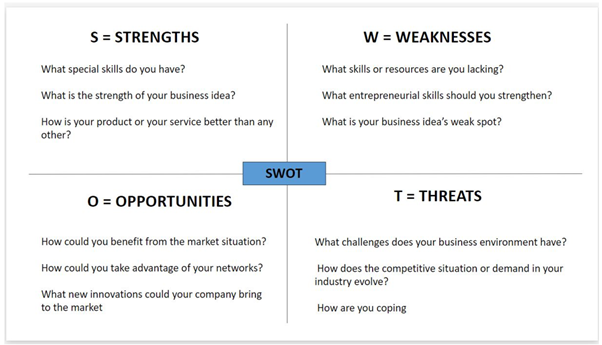
A SWOT analysis is a strategic tool for evaluating and understanding some essential internal and external factors in a business, your experience, knowledge, and strengths. SWOT analysis allows you to map the strengths, weaknesses, opportunities and threats of a business idea, entrepreneur, and company. This technique can also be used at the business ideation stage and will help you understand if you should introduce a new product or service. The following image will give you an overview of SWOT.
Task:

Document all essential strengths and weaknesses, opportunities, and threats on your business idea that you might already have or could possibly have in mind.

Optional task:

After filling done, reflect on all fields shortly, how to maintain strengths and utilize them better, how to improve weaknesses at least on basic level, what opportunities could bring on and how to make them possible, and finally, how to prepare for threats and what plans should be ready upon realization.

4. Business Model Canvas

The Business Model Canvas is a visual representation of the 9 key building blocks that form the foundations of every successful business. It’s a visual overview of your entire business on a single canvas containing these 9 key building blocks:

Customer Segments

Value Propositions

Channels

Customer Relationships

Revenue Streams

Key Resources

Key Activities

Key Partners

Cost

An example of Business Model Canvas: Zara. Note that the example provided is very basic and that your canvases should be more detailed. (See instructions for each part of the canvas below.)
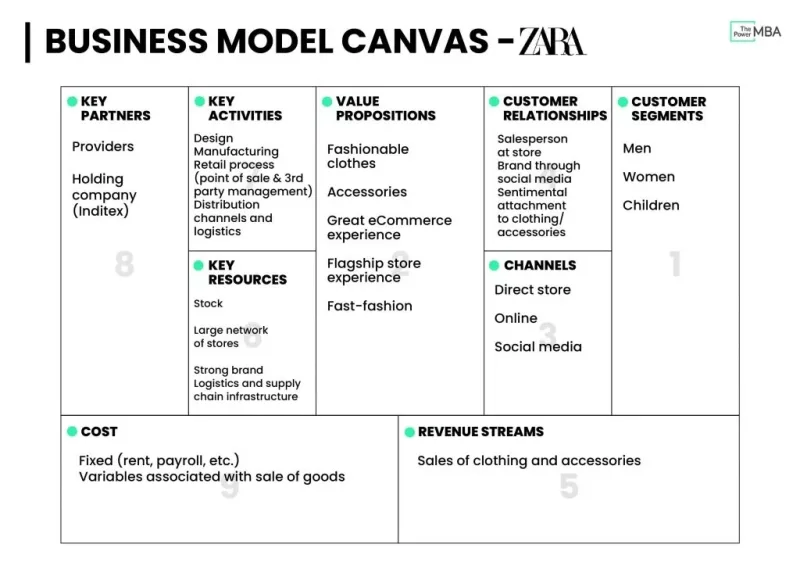
Source: The 9-Step Business Model Canvas Explained (http://thepower.education)

5. Explanations of business model canvas “ingredients”

It is not realistic to try to sell everything to all possible customers. Instead, you need to think about who your product or service is targeted at. This helps you to do more targeted marketing and design products and services that meet their expectations. When you focus your resources on the right customer segments, your use of money and time is more efficient. Describe here which customer groups your company serves. How would you describe your customers? For example, what age are they, what gender do they represent, what kind of things they are interested in, what do they value, and what is their lifestyle like? Describe what problems or needs they have that your product or service addresses.

Describe what unique value you offer to your customers. Explain how your product or service differs from competitors’ products. Why do customers choose your product or service?

Describe how you reach your customers. Explain which channels you use for selling and marketing your products and services to your customers. Where can customers buy your company’s product or service? For example, do you have an online store, a brick-and-mortar store, or both? Specify which social media is appropriate for your business and target group.

Describe how you maintain customer relationships. How and on which channels do you ensure good customer service? Do you have loyalty programs or other customer benefits? Explain how you collect feedback.

Revenue streams refer to all the way your company earns money. Describe the main products or services you sell. Revenue streams can include product sales and additional services offered with them. You can also create partnerships or collaborations and earn income through reselling, joint marketing, or advertising revenue.

Describe the most important resources you need to run your business. For example, what facilities, machines, and equipment do you need to produce your products or services? Do you need staff to run your business? What digital tools and platforms do you need for your business? Describe the raw materials and materials you need to produce your products. How do you handle transportation/logistics?

Describe the most important tasks you need to perform to produce and sell your products and services. Key activities can include, for example, product design and manufacturing, service production, marketing and sales, distribution and logistics, customer service, financial management, and personnel management.

Describe the most important partners you need to run your business. Partners can include suppliers, subcontractors, logistics companies, advertising agencies, social media influencers, banks and financial institutions, organizations, educational institutions, IT service providers, and accounting firms.

Costs are variables associated with sale of goods. You should also plan how much money you need to start your business. What are the starting costs, variable and fixed costs in general.

Case study

Case study 1

Many fruit farmers in Sub-Saharan Africa face major challenges like unpredictable weather, pests, crop diseases, and limited access to advanced monitoring tools. These problems often lead to reduced yields and financial instability, especially for small and medium-sized farms. Aerobotics, a South African agri-tech startup founded in 2014, created a Web 4.0-enabled platform that combines IoT sensors, drone imagery, and AI-powered analytics to give farmers real-time insights into plant health. Farmers receive early warnings about stressed trees, pest outbreaks, or nutrient problems through easy-to-read dashboards that work even on mobile devices.

This technology has helped farmers detect problems weeks earlier than traditional methods, reducing crop loss and improving harvest quality. Aerobotics has scaled across South Africa, Kenya, and even international markets, empowering growers to make data-driven decisions that reduce risk and increase profitability. By merging intelligent systems with local agricultural knowledge, Aerobotics demonstrates how digital innovation can strengthen food security and support sustainable entrepreneurship in Africa.

Why it matters:

Aerobotics shows how Web 4.0 tools — intelligent sensing, data analytics, and predictive systems — can transform traditional industries and create new opportunities for entrepreneurial innovation.

  • Website: https://aerobotics.com/

  • Video:https://www.youtube.com/watch?v=LhAS51lclnQ

  • How does early access to real-time crop data help farmers reduce risk and improve their business outcomes?
Case study 2

Many micro-entrepreneurs in Kenya struggle to access fair and affordable credit because traditional banks consider them high-risk borrowers. As a result, they often turn to informal lenders who charge extremely high interest rates, trapping them in debt cycles. Pezesha, founded by Hilda Moraa, created a Web 4.0 digital lending marketplace that uses AI to assess risk more fairly and match SMEs with responsible lenders. The platform analyses transaction data, mobile money history, and business behaviour to create accurate credit scores.

With this approach, thousands of small businesses have gained access to affordable working capital, helping them grow their shops, restock goods, and survive difficult periods. Pezesha also integrates financial education so entrepreneurs can build long-term stability, not short-term loans.

Why it matters:

This case shows how human-centered digital systems can promote financial inclusion, reduce exploitation, and strengthen local entrepreneurship.

  • Website: https://pezesha.com/

  • Video: https://www.youtube.com/watch?v=Oh7TnjNaXjM

  • Why is responsible risk assessment important for supporting small businesses in digital ecosystems?

Activity 1: Digital Tools in Everyday Life

Digital technology is not only computers and the internet. In everyday life, digital tools include mobile phones, SMS, mobile money, radios, and simple apps.

In many Sub-Saharan African communities:

  • People use mobile money instead of banks
  • Small businesses advertise through WhatsApp or Facebook
  • Farmers receive weather or price information by SMS

These tools already support work, income, and learning, even without advanced devices. Digital entrepreneurship starts by recognising what tools people already use, not by buying expensive technology.

Self-directed task: Sort & reflect

Look at the list below. Copy it on paper and sort each item into one of three columns:

TOOL

WORK 

LEARNING

COMMUNITY

Tools to sort:

  • Mobile phone
  • Mobile money (e.g. M-Pesa)
  • Radio
  • Notebook and pen
  • WhatsApp group
  • Community notice board

You may place one tool in more than one column.

  1. Which tool do you use most often?
  2. Which tool helps you earn money or save time?
  3. Which tool could be improved with digital skills?

Activity 2: Planning Your Own Learning & Skill Growth

Vocational learning is not only about school. Skills grow through:

  • Daily practice
  • Community learning
  • Informal work
  • Problem – solving

Digital skills include:

  • Communication
  • Organisation
  • Basic data tracking
  • Online safety

These skills are important for future jobs and self-employment.

Self-directed task: Match & Plan

Daily activity

  • Using phone to contact clients
  • Keeping a list of expenses
  • Helping family business
  • Sharing information safely

Skills you practice

  • Communication
  • Organisation
  • Problem-solving
  • Digital responsibility

Add one activity from your life.

  1. One skill I want to improve
  2. One tool i already have
  3. One small action this week

Activity 3: Creativity – Turning Everyday Problems into Ideas

Key concept: Creativity is problem-solving

Creativity is not only art or design. In vocational life, creativity means finding new ways to solve familiar problems.

In many communities: Water collection takes time, Transport is unreliable, Information spreads slowly, young people have skills but few opportunities

Creative thinking begins by observing daily challenges and asking:

“What small change could make this easier?”

Digital entrepreneurship often starts with simple ideas, not complex technology.

Self-directed task: Problem -Idea

Pick one problem you see often:

  • Long waiting times
  • Poor communication
  • Lost items or money
  • Lack of customers
  • Difficulty learning skills

 Write three different ways to improve the situation.

Rules:

  • Ideas can be simple
  • No idea is “wrong”
  • Do not worry about cost yet

Example:

Problem: Customers don’t know when shop is open

Ideas:

– Painted sign
– SMS to regular customers
– WhatsApp status update

  • Which idea is most realistic now?
  • Which idea is most creative?

Summary of Key Learning Points

  • Entrepreneurship is about solving real-life problems and creating value, not only about starting a business.

  • Small experiments and smart risk-taking help entrepreneurs learn and reduce uncertainty.

  • Creativity means finding new and practical ways to improve familiar situations.

  • Digital entrepreneurship can begin with simple, everyday tools such as mobile phones, messaging apps and mobile money.

  • Collaboration and sharing ideas with others strengthen learning and business outcomes.

You have now built essential knowledge about entrepreneurship and digital tools, developed practical skills for problem-solving and collaboration and strengthened key attitudes such as confidence, responsibility, and persistence.

Entrepreneurship grows through creativity (seeing problems differently), innovation (trying new ideas) and smart risk-taking (testing small actions and learning from the results). You do not need perfect conditions or advanced technology to begin.

Take what you have learned and apply it in your own context. Choose one idea, use one familiar tool and take one small step forward. Learning continues through action.


Quiz

Module 4 quiz

1 / 10

Which statement best reflects a human-centred digital entrepreneurship approach?

2 / 10

True or False: Making mistakes is a normal part of learning and entrepreneurship.

3 / 10

Which tool is commonly used for quick communication with customers and communities?

4 / 10

Collaboration in entrepreneurship involves:

5 / 10

Why are small experiments important for entrepreneurs?

6 / 10

Which action represents a low-risk way to test a business idea?

7 / 10

True or False: Digital entrepreneurship always requires advanced digital skills

8 / 10

Creativity in entrepreneurship means:

9 / 10

Which of the following is an example of a simple digital tool used in everyday entrepreneurship?

10 / 10

Entrepreneurship in the digital era mainly focuses on:

Your score is

The average score is 0%

0%